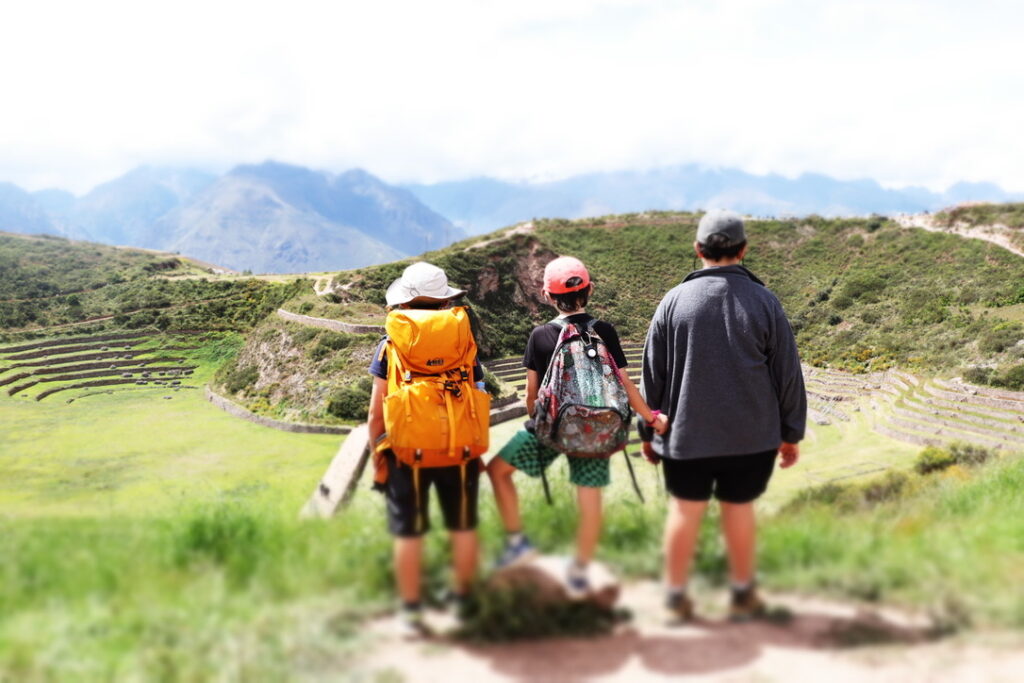
Author: Samuel Randall

  • Power, Belief, and Stone – Exploring the Temple of the Sun and Saqsaywaman

    THE PLANNING OF CUSCOfascinating Curiosities of Cusco

    Something you should know about Cusco is that the city looked very different back in the Incan times. Not just the architecture of the buildings, which was a huge change from incan to spanish architecture. But the shape of the city. The city of Cusco was designed to be shaped like the puma. The animal of power, strength and a connection to the earth, (Kay pacha, in the quetuan language). The Incas had three different animals connecting to different things. The Condor connects to the sky, also responsible for bringing the dead up into the sky, the snake connects to the underworld, and finally the Puma connects to the earth. Saqsaywaman was the head of the puma. Qoriconcha was at the heart. I will explain why later. Now the shape of Cusco is not like a puma. The city now is about 10 times the size of the old puma layout. You have to consider that even though the Incas ruled over a kingdom of 10,000,000 people. Only 40,000 elites lived in the city of Cusco. Now 500,000 people live in the city.

    Saqsaywaman :

    Saqsaywaman could have been the head of the puma for many different reasons. There are many different theories about what Saqsaywaman could have been. A fortress overlooking the great city. A ceremonial site placed at the head of the puma to worship the gods. It was probably a bit of both. Saqsaywaman was definitely my favorite Inca site. It really displays the ingenuity of the Incas. Without the invention of the wheel, or even written language, they were able to place these huge rocks sometimes weighing 200 tons(by the way, that is heavier than an adult blue whale) together perfectly with no mortar. These rocks have been preserved so well because of another amazing invention of the incas. They have made their stones earthquake proof due to them being in an earthquake prone region. How did they do this? They made their bricks, like Lego bricks. They interlocked. With no mortar there wasn’t any mortar to crack, so it was officially earthquake proof. I remember our first walk to Saqsaywaman, I stood completely in awe at the incan architecture

    Qorikancha: The Temple of the Sun

    The great Sun Temple was the center of the incan society; the Incas main god, Inti, was the sun god. In the center of Cusco the temple was placed. At the heart of the Puma. The sun was everything for the inca, and it still is for us today. It grows the crops. Warms the earth. And brings us light. the Incas literally covered the sun temple in gold. Just as they covered the moon temple in silver. The Spanish took all the gold and melted it down to be sent to Europe, but it used to be that even the walls were lined with a thick sheet of pure gold! I know, I didn’t believe it at first too!

    Thats all for this time see you next time on the Salkantay trek!

  • CUSCO: Staying in San Blas, Peru

    We have settled down for 3 weeks in the historical district of Cusco(San Blas). 

    The view from the apartment was incredible. Every roof top was lined with reddish brown brick tile. There were pre Incan walls right across the street from us. With the Andes mountains in the background. It feels like a panting. I have 2 favorite things: Number 1, walking around. It’s amazing to see the Spanish influence mixed with the Incas. Like the day of the earthquakes before Easter, where everyone parades for Jesus not to bring them earthquakes. It’s also interesting to see how the Spanish used religious superimposition to show dominance over the Incas by building the Spanish church right over top of the Inca temples. The Inca architecture is incredible. They were incredible stone masons. There was one brick in Cusco, with 12 sides!!! 

         I learned later that the Incas loved these stones together like legos to be earthquake proof! Number 2 the dogs. The wild dogs of Cusco are the sweetest dogs ever. One will just walk right up to you and sit in your lap. What really shocked me was the altitude. It’s indescribable. All I can say is that 11,000 feet of altitude makes walking feel like running.

        Staying in Cusco was unlike staying in any other place we have visited. When you stay in a place for more than a couple days you really get to know it. Also once you leave you really miss it. 

    Before I went I had always wanted to go to Cusco even before we started the trip. We studied the Incas in 5th grade and I had wanted to go ever since. I can cross that off my bucket list!

    Cusco is really a great city with so much to do and so much to see if you are passing through. Consider taking more than a couple days. Cusco is a special place and I hope to go back one day.

  • Skies of the Andes

    While journeying throughout the Andes, me and my family have seen some of the most beautiful starry skies ever. 

    Written in the stars: How astronomy has shaped the story of Peru -  Wanderlust

    Sadly, on our one chance to see something like shown in the picture, we got rained out. We didn’t take that picture. I thought the skies were incredible anyways, and we didn’t even go in the stargazing season. Which is July. In July they have all sorts of festivals in Cusco. When we were there in May we already saw people practicing for it!

    You probably know that the Southern hemisphere sky is the opposite of the Northern hemisphere sky, but there is something else that is different in Inca cosmology. Instead of using stars to create constellations, like dots to dots. They used shadows like dark and purple in the milky way. Those are called dark constellations. This really caught me by surprise because I have never seen the milky way in real life anyway. Also because the sky is different, instead of using the north star they used the southern cross. During our stay in Cusco we went to the Cusco planetarium. I looked at planets through a telescope for the first time. It was so cool. I also learned how to tell the difference between stars and planets. If it is a planet, it doesn’t blink. If it is a star, it does! The Incas were great astronomers. They were able to predict droughts just by looking at the stars. This way they were able to plan their rations, and make huge food stores to support the Inca empire during these times of drought. The priests of the empire were the only ones allowed to speak with the gods. They were able to convince the people that the gods were talking to them by predicting things through astrology.DARK CONSTELLATIONS OF THE INCA The center of the Milky Way galaxy is  visible in Earth's southern hemisphere, though it is almost entirely hidden  by thick clouds of interstellar gas and dust.Jimmy Westlake: Viewing the Southern Cross | SteamboatToday.com

  •         NAZCA LINES

    How the Nazca Lines were made - Machu ...

            THE NAZCA LINES

    The Nazca lines are a series of hieroglyphics(figures) drawn by sosities 1000’s of years ago. Set in the driest desert in the world. The coastal desert of Peru.

            MY EXPERIENCE

    I was on the ground for the first time when I saw the nazca lines. We were on a bus, we were all really excited, Max pointed out to me a tiny monkey engraved into the rocky sand. What amazed me was that something so small could still be there after more than a thousand years. This is due to the desert’s climate and location. (I will explain about that later). For me, my favorite figure was the hummingbird. Apparently the humming bird Deity was one of their biggests Deities. What is interesting to me is that such a small bird has such a big impact on the culture.

    I loved being out in the desert. The desert mountains made such an interesting landscape. But it’s weird at the same time, having no water and no trees around is a bit stressful, after being in the desert for weeks it is so nice to be back near green up in the andes. Although, all the same, the desert is really, really cool! 

    FROM THE SKY

    During our time in nazca we took a small plane to see the nazca lines from above. It really puts the whole thing into perspective. You really realize how elaborate these drawings are. I am still in awe at how the Nazcans completed such a feat, without the wheel, or a view from above!

                   BURIAL GROUNDS 

    The moment that I will never forget is walking to the ancient nazca burial site and seeing human bones scattered on the ground. This was reminise of tomb raiders. The Nazcans were buried with some of their belongings so if you were a royal Nazcan you would most likely be buried with gold and other precious metals. This attracted tomb raiders who would go around banging the ground with a pole to determine where the ground was hollow. Where it was they would dig. After digging up these metals. They would leave the bodies in the ground all torn how they had left them. Over time sand would blow in covering back up the hole. Which results in the human bones lying on the surface of the sand.

          BUILDING OF THE NAZCA LINES

    THE SCIENCE BEHIND THE NAZCA LINES CONSERVATION

    Some lines have lasted all the way from 500 BCE. That’s pretty impressive. The climate with little rain and little wind helped preserve the nazca lines. Although some lines have been lost and are not visible to the human eye anymore.

    Scientists still are researching to verify the purpose of the nazca lines and how they were built, and even the timeline of when each one was built. New AI scannings are continuing to help us to identify even more lines. By using drones to take pictures and scan them with AI. Ones not visible to the human eye anymore. 

    SEE YOU NEXT TIME 

    The nazca lines are still sort of a mystery to everybody, but they are really cool to go and see and I recommend it if you are in the area. The mysterious story behind it still fascinates me. How the nazca lines are still sort of a mystery to everybody, but they are really cool to go and see and I recommend them. See you next on the floating islands of the Iros people on lake titicaca!

  • Huacachina

    DUNE EXPERIENCE:

    When visiting the dunes of Huacachina we rode dune buggies, did sand sledding, and skiing, and saw a desert sunset.  The dune buggy rides were probably some of my favorite parts. Our driver was very skilled. He took us down and up steep dunes and used dunes like half pipes to pick up speed. 

    The desert was completely like nothing I have ever seen. There were huge sandy dunes for as far as I could see! It was super hot and very dry. It was cartoonishly insane! If you were alone out there, and you closed your eyes, it would be silent. All you would be able to hear or see or feel was the sand stinging your legs.

    Many things surprised me. The sunset out on the dunes was very beautiful, more beautiful than the ocean. Our sand sleds also went a lot faster than I thought! As the dunes were a lot steeper than I thought.I experienced so many things all at once excitement on the dune buggies. Then on the sleds, nervousness, and excitement again, but also in awe of the size of the dunes. The sunset was so beautiful, I will never forget that sunset.

    The dune sledding is also very memorable. The first time I went down a steep dune is something I will never forget. The speed you can pick up on those things is crazy! Finn wiped out once, but he was fine. Finn is a trooper, in less you tickle him!

    LOCAL FOLKTALE:

    The local Folktale on how the lagoon was created is the legend of the mermaid. It is connected to the town because the only reason Huacachina is there is because of the lagoon . Here is how the story goes: An Ican princess was being chased by a hunter. Upon her escape, her mirror shatters creating the Lagoon and transforming her into a mermaid. She dives in to escape the hunter and now, supposedly, she can be heard singing a song when the moon lights up the lagoon!

    People believe the lagoon has healing properties due to the local legend. Historically, tourists have come to relax in the water and mud for its healing properties.

    CREATION AND CONSERVATION:

    The sand dunes are made by blowing sand coming from the beaches. The farther you get from the ocean, the more rock, and less sand. Tourism is leading to increased need for water for hotels, stores, and restaurants. Water is becoming scarce due to over drilling of the aquifers. The people are now pumping water into the lagoon to preserve it!

     Huacachina is a magical place and I hope to come back when I am older!

  • Arequipa Peru

    This week we stayed in arequipa and explored the “White City”

    ARCHITECTURE AND MONASTERY

    During our time in Arequipa, we went to Santa Catalina Monastery. While we were there we took a guided tour of the Monastery. What was interesting to me, is that the monastery also sort of served as a community center for that part of the city. It had a bakery that was used for the people in that part of the city. There was also shelter for the city if there was ever war.

     The Santa Catalina Monastery is like its own significant city, within a city! It represents the city’s history and contains preserved colonial architecture !  It was very cool to see the difference in architecture between the Catholic Spanish, and the rest of the city. It is cool to see how they blend! The city’s architecture was very strange. All the buildings are made from volcanic stone and are built out of white volcanic stone. I know Arequipa is very close to volcanoes, but it is amazing they can produce so much stone! Arequipa is literally called the white city because of the massive amounts of volcanic stone which, obviously is white! The picture to the right is the cathedral of the city. Which is white!

    Arequipa - Wikipedia

    FOOD

    We did go out to lunch and dinner many times, but we never ate the street food. We did walk by some though. We walked by a fried guinea pig. Although, I don’t think I could ever force myself to eat one! Every time we walked by a restaurant or bakery we would be drawn in by the smells. The Peruvian food there is some of the best food I have ever had! Highly recommend chicken soup anywhere in the andes. Also, note that wherever you go, potatoes will be served on the side.

    MUSEUM OF CHILD SACRIFICE

    The moment that stuck with me was when our mom took us to the Arequipa museum of child sacrifice. That was really cool! There we learned about Junita, a frozen child mummy. During rough times the Incas used to sacrifice the children. They believed the mountains were gods! So what they did is they would take the children up to the top of a volcano or mountain. Then they would feed the kids fermented corn juice. The alcohol would make the kids black out very quickly. Then they would beat them to death with a club by fracturing their skull.

    GEOGRAPHY!

    The volcanoes were gods to the Incas; they were the place for child sacrifice. Much of the stone that is nearby is a volcano. The main volcano there is El Misti, a stratovolcano. This volcano is still active so it is a constant threat to Arequipa!  Almost all the stone in the city is white volcanic, the buildings, the walls and more! The El Misti volcano is expected to erupt anytime soon and nobody is doing anything about it. Freaky! Arequipa is also prone to frequent earthquakes. So, in some places, there is special architecture to protect from them. In the monastery, there are arches over beds to protect from them!

    TOURISM INDUSTRY

    There are many things to do there, although we didn’t get to do all of them. For one, Arequipa has a major alpaca wool industry. Which you can visit and take tours of. We got to visit a museum. The alpacas are SOOOO SOFT! Also nearby people hike Misti Volcano, and there is the Colca Canyon not too far from Arequipa. It is known for its depth and soaring condors up above.

  • The Ingenuity of the Incas: Moray and Maras Journey.

    Today is my birthday, I turned 12. We are going on a day trip to our worldschooling hub today! We have been able to explore many Inca sites in Cusco, today we are exploring the site of Moray, and the salt pools of Maracas

    The Inca site of Moray is a series of terraces used for agricultural purposes high up in the mountains. It was used like an agricultural laboratory for engineering and developing potatoes and other crops.The Inca may have used Moray to experiment with crops and what microclimates they thrive in. Did you know the Inca developed over 4,000 types of potatoes? The Inca may have seemed to you like way behind modern, or even the Spaniards inventions and standards, for example the invention of the wheel, and firearms, and writing. But they were great scientists in agriculture, and astronomy. They were even able to predict droughts and changes in rainfall and weather patterns. Like the El Nino year. An effect happening approximately every 5 years that can bring drought and weather changes to Peru. They could figure this out  by just measuring the brightness of the stars. The site felt so special. It felt like hundreds of years of ancient, but advanced agricultural science way ahead of its time was built up right where I was standing.
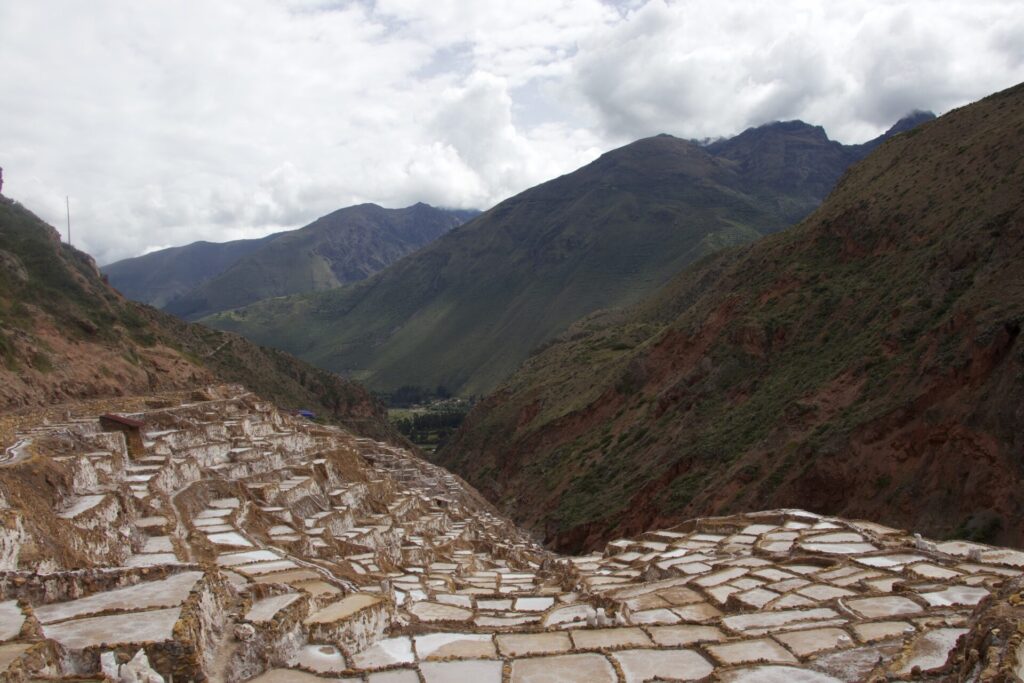
    Maras: The Salt Pools

    The salt pools of Maras are an ancient salt farm, used by the Incas, and now owned by local families today! The salt pools of Maras harvest salt from a nearby underground saltwater stream 3 times saltier than the sea. They use mini trenches to make the salt water flow from the stream to the pools. The trenches can be closed off from the salty stream when the pools have been filled with the salty water. Then the water will sit in the pools for weeks and all the salt would be left behind while the water evaporates. Then the people working at the pools would scrape up the salt with tools.

    This system could be less sistanable if the stream dries up, or if a big rain resets the process of the salt evaporating, by dissolving the salt. Although this system is an environmentally friendly system they harvest the salt without destroying the earth.

    Out of the 5,000 salt pools they are owned by 625 families. The salt that is not sold in the gift shop is taken to other markets to be sold. The tourism industry also helps the business with entry fees and visiting the gift shop. The value of salt to the people living in peru has greatly dropped over time. Believe it or not, salt was more valuable than gold to the Incas. It was used to preserve food, so it must have been really important without a freezer!

    I think in the future we should all try to be a bit more like the Incas …in some ways, not including child sacrifice please!. We should try planting different varieties of plants so a blight doesn’t destroy a farmer’s life savings. Hopefully we can learn to get by without harming the earth like the incas. 

    I have never been so interested in school. In public school, history was ok… at least, not the worst subject.  But, now I get to actually experience what I’m learning! I am comparing real life to what I am reading and learning about each day. It makes the class so much more engaging! Same with geology and science I will be studying about geothermal activity, and then the next day we will visit a geothermal energy farm.

  • CRADLE MOUNTAIN NATIONAL PARK

    This week we stayed at Cradle Mountain National Park. Or in my dads words, “The land of the “teddy bear pigs (wombats).” In my words “a portal to another world based on the jurassic period. I say this because it is so different and a bit freaky at times. 

    ANIMALS!

    Throughout our stay we saw many animals. We saw a lot of 

    wallabies (small kangaroos), and paddamelons (small wallabies) hopping around in fields, some wombats (teddy bear pigs?), SO MANY LEECHES (sucks your blood), billions everywhere. My advice: stay on the boardwalk! Plus, we even saw a Tasmanian devil (creepy screechy thing)! Zoom in on each animal, (trust me)!

    Wombats!

    SLEEPING IN THE PARK

    Sleeping in the park was very cool. We had to boil our water, dry and wash our own clothes! My favorite part of staying in the park overnight was that we got to see and learn about all sorts of nocturnal animals, like wombats and Tasmanian devils. I learned a lot throughout Tasmania about the early aboriginal people and their interactions with the Europeans there. I can imagine the Aboriginal people having infinite food. The wallabies are more curious than scared and the wombats will come right up and sniff you! I also learned about Gustav Weindorfer. He was the lodge keeper and protector of the park, even before it was a park. We got to see all the different ecosystems of Tasmania, like eucalyptus forests, grass hills fit for a hobbit, and even windy mountain tops.

    WALKING EARLY IN THE MORNING

    When we took a walk through the park at 4:00 AM we saw and heard more wildlife than I had ever seen. We saw many many many many many many many many wallabies, many many many many many many many many wombats, and a couple pademelons. The sunrise is very beautiful.

    WALKING LATE AT NIGHT

    The difference between Cradle Mountain and the northeastern United States is unexplainable. I will try my best anyway though! In short, the birds there sound like dinosaurs, there are teddy bear pigs with iron butts, and there are mysterious creatures in trees that scream when you point a light at them! When we took a walk in the evening, we saw many wombats, some wallabies, and of course, scary mysterious creatures in trees that scream when you point a light at them, like the Tassie devil! All these animals are so different from what we have in NJ. 

    ABOUT THE WALLABY

    Wallabies are marsupials just a bit smaller than a kangaroo, basically the same. It has a pouch and everything too. They are social, but we did see them fight once!

    ABOUT THE WOMBAT

    The Teddy Bear Pig (the wombat) is a fluffy, furry, brown pig with lots of fur! They are bigger than a tassie devil but still less tall than my knees, and about as long as from my toe to my thigh. Their main defense is blocking up their den with their steel like butts to keep predators from eating their offspring! When a snake or devil tries to sneak in, they crush their skulls with their butts.
    ABOUT THE DEVIL

    The Tasmanian Devil is a small animal,  but it is the apex pretetor in tasmania. Having a bite force and muscles up to 40 times stronger than the average human, they can take down anywhere from pademelons to wallabies. By the way, wallabies are as tall as Max, and Tasmanian Devils are only up to my knees! Hearing them at night is one of the scariest things ever! Especially when you forget your headlamps. I learned that one the hard way!


    ABOUT THE scary mysterious creatures in trees that scream when you point a light at them

    Don’t know a lot about them as they are mysterious creatures.

    Hiking to Maryanns lookout

    On our first day we hiked up to Maryanns lookout! Sadly we had bad weather so we couldn’t see much. It was foggy, wet and cold. Although it was fun. The wind at the peak was crazy. We had to hold Finn so he didn’t blow away! Going down, we went down holding on to chains, it was really steep. By the end though everybody just wanted a hot shower.

  • Echidnas

    We visited the Sydney zoo last week. There were lots of cool animals like the Kangaroo – Famous marsupial with powerful legs for hopping. Koala – A nocturnal tree-dweller that eats only eucalyptus Wombats – Bear like, beaver? (Very strange!)Kookaburra – The world’s largest kingfisher bird  Dingo – A wild dog that feeds mainly on small animals. Frilled-neck lizard – A reptile that runs on two legs when threatened. Tawny frogmouth – A master of camouflage that looks like a tree branch. Platypus – A bizarre egg-laying mammal with a duckbill. Echidnas – The strangest animal known to mankind(in my opinionSydney funnel-web spider – The world’s deadliest spider. Quokka – Known as “the world’s happiest animal” due to its cute smile. Tasmanian devil – A tough scavenger with the strongest bite for its size.

    The most interesting animal to me was the short beaked Echidna. I didn’t know a lot about it so I did some research. Here’s what I learned:Echidnas are found throughout almost all of Oceania, mostly Australia. All throughout mainland Australia, as well as Tasmania. They are Australia’s most widespread native mammal. Echidnas are found in almost all habitats from snowy mountains to deserts in the Australian outback.The Echidna is an amazing animal with amazing adaptations the echidna is sort of like a spiny anteaterIt has long sharp spines and a long tongue to eat ants. Like a hedgehog, the Echidna has an amazing sense of smell to find ants. They also have something else that’s amazing… Echidnas can sense the electromagnetism that every living thing gives off. It is the only land animal able to do this. The echidnas also have super strength. Although only weighing up to 3 pounds, Echidnas can push boulders and mounds of dirt weighing 44 pounds. When threatened, echidnas roll up into an impenetrable ball( Warning, very spiky!) Echidnas spines look just like soft fur so be carful!
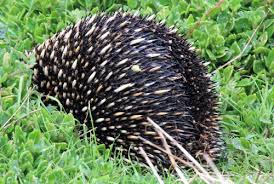
    Echidnas are awake during the day, but can be found hunting at night in the warmer months. Ecdnias make burrows to shelter them and their young (they are solitary but raise their young for 6 months!). Even though being a mammal, echidnas lay eggs. It is the only animal like this besides the platypus(a extremely cute, small furry friend with a duck beak)Baby Short Beaked Echidna

    Adult echidnas have few predators but there are some dingoes, goannas, foxes, domestic dogs, feral cats, and eagles(although snakes usually aren’t a problem, they can sneak into burrows and feed on their puggles(offspring). Echidnas are not endangered but their biggest threat is introduced species, but if they were to go extinct it could be bad. Echidnas turn the soil to help plants grow, they also control populations of other species, acting as prey or predator. My favorite thing about Echidnas is that they have offspring called puggles. Puggle is very fun to say!

  •  Tūna(The Fascinating Longfin Eels of NZ)

    The Longfin eels live in the rivers of New Zealand. They are known as Tūna in Maori, and can get up to 6 feet long. Longfin eels hatch in the deepest canyons of the Pacific Ocean, and then take a huge journey to New Zealand. I have seen these eels lots of times in New Zealand so far. They are important to the New Zealand aquatic environment. They keep small fish, aquatic snails, and worm populations under control. Also they can only be found in New Zealand!

    There are many stages in a Longfin Eel’s life cycle. The Longfin Eel story starts when they hatch from eggs into larvae in the pacific ocean. Soon they will be carried by ocean currents to New Zealand. Then they gradually change into Glass Eels(the name is descriptive, they are see through, like glass).

    Tuna – working with glass eels ...

    .As they enter estuaries they gain color, as this is happening they are changing into Elvers. These small adult Longfin Eels (Elvers)  journey to find a good place to live. Elvers can climb up dams, rocks, and even waterfalls. They can be out of water for up to 5-7 days! As an adult Longfin Eel , being in a river you are at the top of the food chain. Eating small fish, small birds such as ducklings,t! Mysterious Freshwater Eels of New ZealandThey are harmless to humans, but they can bite if they think you are food. After up to 80 years they travel back to the Pacific to lay up to 20 million eggs, and then they die.

    Longfin eels have amazing Adaptations they can breath through their skin, thus letting them be out of water for 5 days! They are able to climb rocks too, these allow them to find good homes. They live up to 80 years so they can grow slowly and due to their unique life cycle. Female eels live longer due to their slow growth. Eels are really important to the New Zealand ecosystem being at the top of the food chain they keep marine aquatic populations under control. The Longfin Eels are super important to New Zealand and really cool to learn about.

    Sadly Longfin eels are on the brink of extinction. Humans have affected them by overfishing, 1 person can catch 6 per day! They are threatened by habitat destruction. Pollution like nasty sewage water, and toxic mining  materials can remove oxygen are also threats. Global warming has changed ocean currents making the journey to breed harder. Droughts can affect up to half the Longfin eel population. Lastly, even competition and newly introduced predators affect many eels.

    Longfin eels are very important to the river ecosystems in New Zealand. Even though they are big, they are harmless to humans. You can even pet them and feed them (I did). They are very friendly. You can help by supporting Eel conservation efforts, or just wasting less energy to burn less fossil fumes. The Longfin Eels were pulling through just fine before humans came along. Now it’s our time to protect them!